Sunday, 20 September 2026

Roll Forming Machine Guide: 5 Industries and the Process Behind Every Profile

Roll Forming Machines: One Process, Five Industries

Short answer: a roll forming machine bends a flat steel coil into a finished profile by passing it through a sequence of shaped rollers. No heat. No welding inside the forming line. One continuous process from coil to cut-to-length profile.

The full version of this topic is an 8-chapter process guide at Beli Rollforming. Here is the short version.

The process in one paragraph

The coil enters an uncoiler, passes through forming stations that bend it progressively, and exits as a finished profile cut to length in line. Gauge sets the line speed. Material behavior - work hardening, springback, coating - sets the number of stations. Get the flower pattern right and the rest follows.

Where these machines earn their keep

  • Construction - C and Z purlin lines are the most common roll forming machines sold worldwide.
  • Solar and energy - mounting rails, strut channels and brackets for ground mount and rooftop arrays.
  • Material handling - racking uprights, shelf panels and box beams for warehouse systems.
  • Electrical - cable tray and cable ladder lines, one of the fastest growing categories.
  • Roofing and cladding - standing seam, PBR, spandek and custom corrugated panels.

Why the profile list matters before the price does

The same machine family serves all five sectors, but tooling, tolerances and speeds differ between them. A buyer who fixes the profile list first avoids paying for stations that never run - and avoids discovering after commissioning that the line cannot form the profile the contract actually needs.

Read the full article: Roll Forming Machine Guide: 8 Chapters of Proven Process Knowledge

Container Roll Forming Machines: 5 Profiles, Specs and 2026 Prices

Container Roll Forming Machines: A 2026 Buyer Snapshot

Short answer: a container roll forming machine turns Corten or high-strength steel coil into corrugated side panels, roof panels and structural rails for ISO containers and highway trailers. The line that wins is not the fastest one. It is the line that holds corrugation depth tolerance.

We just published a full buyer guide on this topic at Believe Industry Company. Here is the short version.

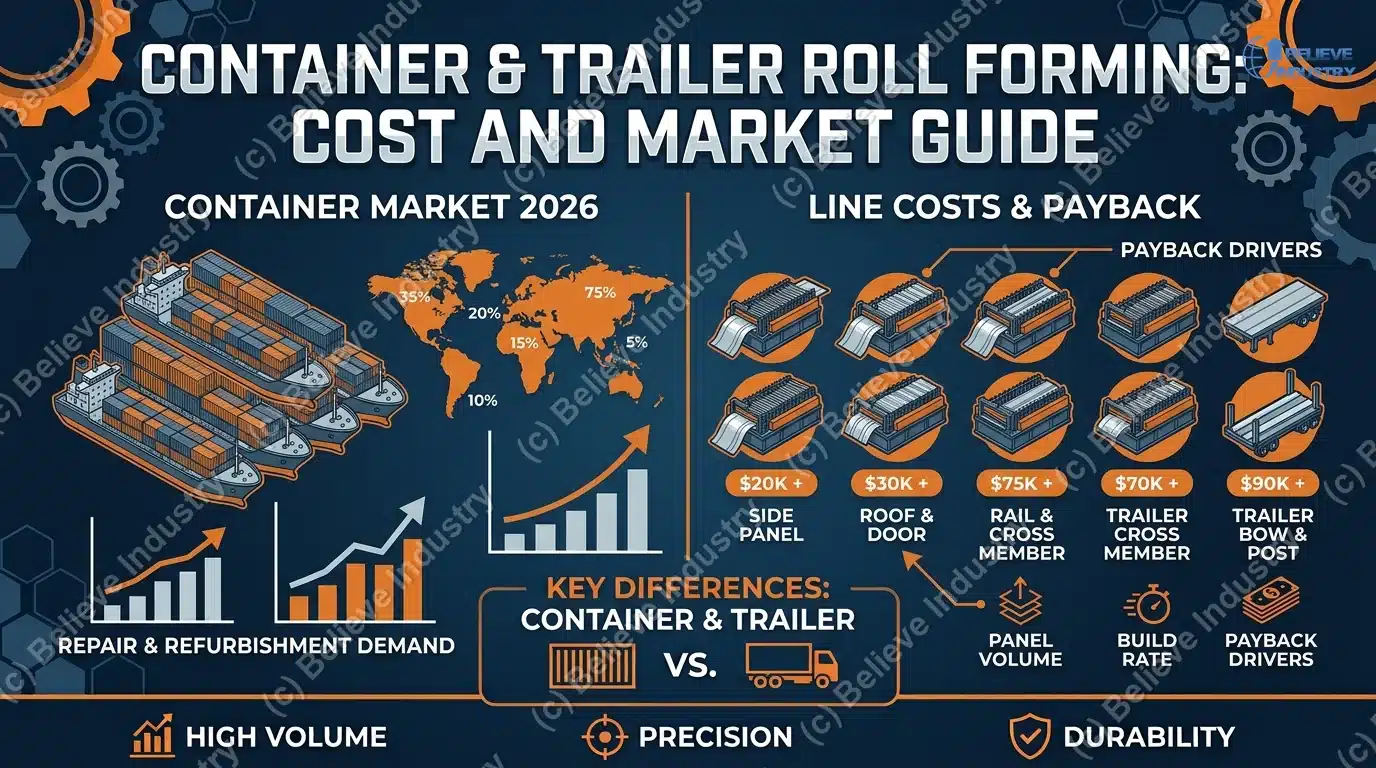
The 5 transport profiles

  • Container corrugated side panels - Corten A / SPA-H, 1.6-2.0 mm, 36 mm deep corrugations at 208 mm pitch, 12-20 m/min on 22-30 stands.
  • Container roof and door panels - 5 round waves, 20 mm deep, 210 mm pitch, 15-25 m/min.
  • Bottom side rails and floor cross members - about 4.5 mm SPA-H, the highest-margin profile to make in-house.
  • Trailer floor cross members and chassis side rails - Q345 / A572 Gr.50, 3.0-4.6 mm, 3-4 inch channel sections.
  • Trailer roof bows and side wall posts - Galvalume or pre-painted, 0.8-1.6 mm, up to 35 m/min, optional in-line arching station.

Why tolerance beats speed

A 36 mm corrugation depth with a plus or minus 1.5 mm tolerance is what lets a 192,000 kg stacked load pass through the corner posts. Miss the depth by 3 mm and the panel fails the vertical load test the whole container design depends on. That is the difference between transport-grade and general-grade equipment.

Price ranges at a glance

  • Container side panel lines: $180,000 to $420,000
  • Roof and door panel lines: $120,000 to $260,000
  • Bottom rail and cross member lines: $90,000 to $200,000
  • Trailer cross member and side rail lines: $110,000 to $240,000
  • Trailer roof bow and wall post lines: $70,000 to $180,000

The 2026 market angle

New container production in China dropped about 20 percent in 2025 and is forecast at 4.5 to 5 million TEU for 2026. The steady replacement cycle is now in repair, retrofit and modular conversion yards, not in new box plants. That changes which profile you should invest in first.

Read the full article: Container Roll Forming Machines - 5 Transport Profiles for 2026 for the complete spec tables, the 8-point buying checklist and the FAQ.

Believe Industry Company has built and commissioned roll forming lines in more than 20 countries for over 15 years, including container side panel, roof panel and structural lines. Every corrugation depth is profile-gauge and laser measured at three points and recorded in the FAT report.

Roll Forming Machine Guide: 5 Industries and the Process Behind Every Profile

Roll Forming Machines: One Process, Five Industries Short answer: a roll forming machine bends a flat steel coil into a finished profile ...